
Food 104: FOOD WE MAKE
Food Is Never Just Something We Eat
So far, we’ve grown the food.
We’ve followed it through markets and into the hands of the people who sell it.
Now it has made its way into the kitchen.
And in Haiti, of course, the kitchen is about much more than cooking.
Klas nan sesyon.
Food is one of the ways Haitians care for one another.
There is a question you will hear all the time:
Ou manje deja?
Have you eaten yet?
It sounds like a simple question.
But it often means something much bigger.
Are you okay?
Have you been taken care of?
Can I get you something?
Because in Haiti, feeding someone is an expression of care. It’s the equivalent to “I love you”
You Cannot Come to My House and Leave With Nothing
Stop by someone’s home in Haiti and there is a good chance you will be offered something, even if just coffee for someone doesn’t have much.
Hospitality is built deeply into how we relate to one another.
We are a hosting people.
There is a sense that if you enter someone’s home, you should be offered something. And many Haitians would rather inconvenience themselves—or stretch what they have a little further—than have someone leave feeling they were not properly received.
The Kitchen Is Also a Place of Knowledge
Of course, somebody still has to turn all of those ingredients we’ve been following into food. And Haitian cooking carries its own body of knowledge.
How much epis?
- Until it tastes right.
How long should it cook?
- Until it’s ready.
How do you know?
- You know.
Learn how to make a Haitian dish with Fonkoze USA director and Chef Alain
Many of us learned recipes through written down. But for generations Haitian culinary knowledge has moved the same way so much of our cultural knowledge moves: from person to person.
- You watched.
- You helped.
- Someone corrected you.
- You tasted.
- You learned.
- The kitchen is its own classroom.
Techniques, flavors, ingredients, and recipes move through generations, and each household adds something of its own.
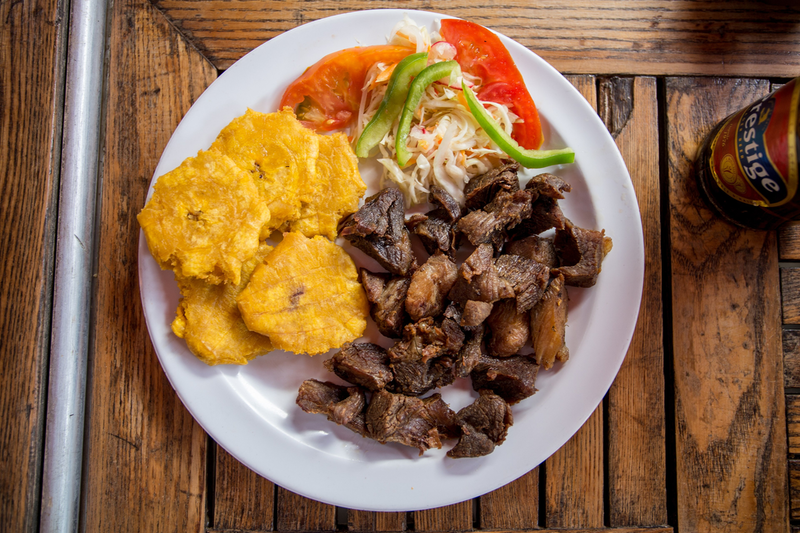
Which is why the same dish can taste completely different depending on whose house you are eating in.
From Ingredients to Value
But making food isn’t only cultural.
It is also economic.
Remember our mango?
A farmer can sell a mango. A machann can sell that mango again. But someone else can turn that mango into juice.
Or jam.
Or preserves.
Or a dessert.
Within our culinary repertoire we have built in value additions.
The same thing happens across Haiti’s food economy.
Peanuts -> manba.
Cassava -> kasav.
Sugarcane ->rapadou or kleren.
Cacao -> chocolate.
Fruit -> juice, jam, or preserves.
Flour -> bread and pastries.
Raw -> become prepared meals.
Every time food is transformed, there is an opportunity to create additional economic value and strengthen cultural transmission.
And behind that transformation is another group of entrepreneurs, many of whom Fonkoze supports.
- Cooks.
- Bakers.
- Caterers.
- Street-food vendors.
- Restaurant owners.
- Food processors.
- And chefs.
Food entrepreneurship is part of the larger food system too.
Making Food Makes Community
But there is something else happening when we cook.
We are preparing something that will eventually be given to another person, it’s community event.
Quick Facts
🍲 Haitian culinary knowledge has historically been passed through families and communities, often through observation, participation, and oral instruction.
🍲 Turning agricultural products into prepared or processed foods can create additional economic value and new opportunities for entrepreneurship.
🍲 Food businesses exist at many scales—from home kitchens and street vendors to bakeries, caterers, processors, restaurants, and professional chefs.
🍲 Food entrepreneurship connects several parts of the food system: agriculture, commerce, transportation, processing, hospitality, and culture.
🍲 In Haitian culture, offering food or drink is an important expression of hospitality and care.
Ou manje deja?
Lekòl lage.