Architecture 106: Revolutionary Fortresses
Citadels & Revolutionary Architecture- Fortresses of Freedom and Black Sovereignty
Klas nan sesyon.
After Haiti won its independence in 1804, the leaders of the newly formed nation faced a terrifying reality: the possibility that France — or another European power — might return to try and re-enslave the population and reclaim the colony.
These worries were grounded in reality as Spain came back for the western side of the island, and France came back in 1825 to demand payment.
The memory of slavery was still immediate. Many people who had fought in the Haitian Revolution had themselves been enslaved only years earlier.
So Haiti began to build fortresses.
Massive stone structures were constructed across the mountains and coastlines of Haiti as part of a defensive network designed to protect the world’s first Black republic.
These structures became some of the most powerful examples of revolutionary architecture anywhere in the world.
Building a Nation That Refused to Return to Slavery
The most famous of these fortresses is the Citadelle Laferrière, often simply called the Citadelle.
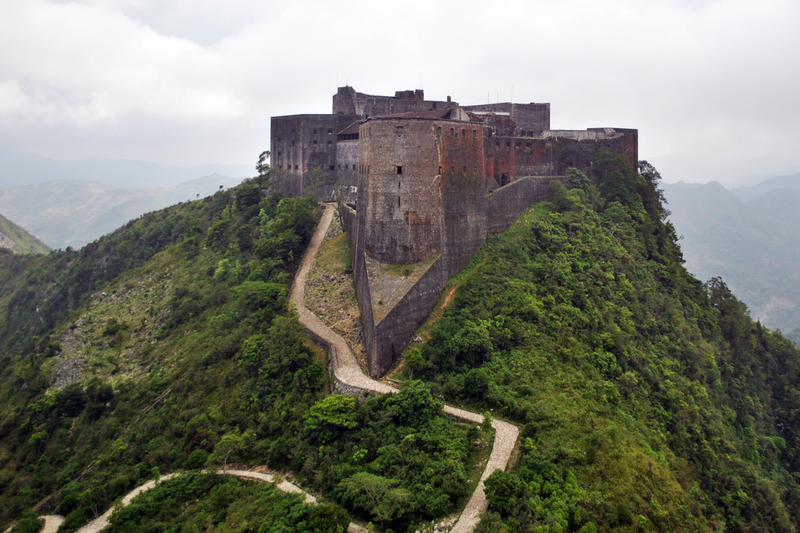
Built under the leadership of Henri Christophe in the early 1800s, the Citadelle sits high atop Bonnet à L’Evêque mountain in northern Haiti.
From its position, soldiers could see far into the distance, making it difficult for invading forces to approach undetected.
The fortress was designed as part of a larger defensive system that included:
- forts
- watchtowers
- armories
- mountain pathways
- and nearby royal and administrative structures such as Sans-Souci Palace
It was meant to send a clear message to any potential invaders that Haiti planned to remain free.
Architecture as Resistance
European powers had insisted that formerly enslaved Africans could not govern themselves, organize complex societies, or create advanced infrastructure.
Yet Haitians constructed one of the largest fortresses in the Americas.
Built largely from stone, brick, lime, and locally sourced materials, the Citadelle required extraordinary engineering knowledge and labor coordination. Cannons were positioned throughout the structure, many taken from European colonial powers themselves.
The mountain became part of the fortress.
Revolutionary Architecture Across Haiti
The Citadelle was not the only revolutionary structure built during this period.
Throughout Haiti, forts and defensive structures were constructed as part of the country’s early military strategy.
These included:
- Fort Jacques
- Fort Alexandre
- coastal defense systems
- military roads
- and regional strongholds
Many were intentionally placed in mountainous terrain, reflecting lessons learned during the Haitian Revolution itself, where formerly enslaved fighters used Haiti’s geography strategically against European armies.
Beyond Defense: A New Vision of Haiti
These buildings were also attempts to imagine what a free Black nation could look like.
Structures such as Sans-Souci Palace reflected aspirations toward statehood, governance, diplomacy, and national identity.
The palace itself blended influences from:
- European palace architecture
- Caribbean climate adaptation
- and Haitian political symbolism
Together, the Citadelle and Sans-Souci formed part of an ambitious post-independence vision:
a sovereign Haiti capable of defending itself while creating its own political and cultural future.
A Global Symbol
Today, the Citadelle Laferrière is recognized as one of Haiti’s greatest historical and architectural achievements and is part of a UNESCO World Heritage Site alongside Sans-Souci Palace and the Ramiers complex.
Forgotten Palaces & Revolutionary Ruins
Across Haiti, especially outside of Port-au-Prince, the landscape is scattered with the remains of forts, palaces, military structures, colonial buildings, and grand countryside homes that many people outside the country rarely hear about.
Many of these structures are now in varying states of disrepair.
One important example is the Palais de la Belle Rivière near Petite-Rivière-de-l’Artibonite, sometimes called the Palais aux 365 portes (“Palace of 365 Doors”). Associated with the era of Henri Christophe, the palace reflected the ambition of post-independence Haiti and the desire to build monumental structures that symbolized permanence, governance, and sovereignty. If we are being honest, sometimes they more so reflected a European facing lens in their domineering presence, which contrasted to our historical communal ways of living that centered on children & matriarchal living.
Local stories describe the palace as having:
- 365 doors for the days of the year
- 52 windows for the weeks
- symbolic connections between architecture, time, and power
There aren’t actually 365 doors, it’s symbolic. The hyperbole in the story itself reflects how deeply these structures live within Haitian cultural memory, they become their own folklore.
Political instability, natural disasters, lack of restoration funding, urban pressure, and economic hardship have left numerous historic structures vulnerable to collapse or abandonment.
They remind us that Haiti’s architectural history is far richer, more expansive, and more complex than many outside narratives suggest.
The ruins scattered throughout the country are evidence of the many Haitis that existed before.
Lekòl lage.