Architecture 102: Lakou: Community, Land, and Shared Living
Lakou: Community, Land, and Shared Living
Klas nan sesyon.
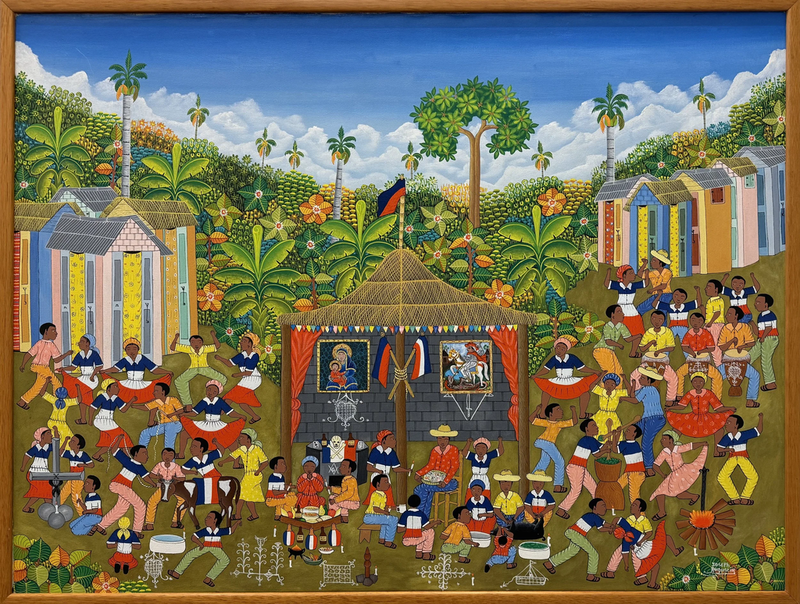
Painting Credit: Vodou Ceremony in a Lakou (Seremoni Vodou nan yon Lakou), by Joseph Augustin
One of the most important traditional living systems in Haiti is the lakou.
It is not simply a form of architecture. It is a way of organizing family, land, labor, spirituality, and community life.
To understand why that matters, think about someone like Rosenie Daniel.
Rosenie is a single mother and a Fonkoze client who operates a small retail food business. Through Fonkoze, she has accessed microloans, business skills training, and individual support to grow her business. But when Rosenie talks about what that business has made possible, she doesn’t describe its impact only in terms of herself. She talks about being able to support her children and create possibilities for their futures.
That relationship between the individual, the family, livelihood, and the generations that follow is a useful place to begin understanding the lakou.
Read More About her Story: https://fonkoze.audela.work/client-stories/rosenie-daniel-micro-loans
So, What Is a Lakou?
The word lakou literally means “yard” or “courtyard” in Haitian Creole, but culturally it can refer to a shared living compound, often made up of multiple homes organized around communal space.
Children play there. Families may share water and other resources. Cooking, gathering, work, prayer, and even burial may all take place within the same interconnected space.
The lakou is physical, but the system is bigger than the buildings.
While the lakou developed into a distinctly Haitian system, scholars and cultural historians have traced elements of it to communal traditions that existed in West and Central Africa and among the Indigenous peoples of the Caribbean before colonization.
Across many African societies, extended families lived in compounds organized around shared courtyards, collective labor, kinship networks, and multigenerational living. Space was frequently organized around community rather than strict individual separation.
These systems often emphasized:
- collective responsibility
- family interdependence
- respect for elders and ancestors
- communal childcare
- shared economic life
Africans forcibly brought to Saint-Domingue carried more than their labor. They carried architectural knowledge, agricultural systems, building techniques, environmental knowledge, spiritual traditions, and ideas about how families and communities function.
In Haiti, these traditions encountered and blended with Indigenous relationships to land and environment, the realities created by plantation slavery, maroon communities, post-independence rural life, and developing Haitian cultural and spiritual practices.
The result was something distinctly Haitian: the lakou.
Women, Lineage, and Community
Another important layer in understanding the lakou is the role of women and matrifocal community structures.
Before European colonization, Taíno societies on the island of Ayiti included systems in which kinship, inheritance, and political succession could be connected through maternal ancestry. The precise organization varied, and terms such as “matriarchal” and “matrilineal” should not be applied universally, but women and maternal lineage held important social and political roles.
Across West and Central Africa, there were also societies in which inheritance, clan identity, spiritual authority, land relationships, or social belonging were organized through maternal lineage, or in which women occupied central roles in communal life.
Colonization and enslavement violently disrupted these systems, but they did not erase them.
Elements continued to develop within Haitian society and can still be seen in the central roles women frequently occupy within families and communities:
- grandmothers anchoring multigenerational households
- women managing markets and informal economies
- mothers organizing extended family networks
- elder women carrying family memory, healing knowledge, spiritual traditions, and caregiving systems
And this brings us back to Rosenie.
Her story is about a woman running a business, but it is also about what that business allows her to do for her children. Fonkoze describes its relationship with Rosenie as a partnership: it provides financing and development services, while Rosenie does the daily work of building the business that supports her family.
Her story is modern, but the underlying idea is familiar: economic life is connected to family life.
A System That Also Protected Land and Family
The lakou became especially important after the Haitian Revolution.
After independence in 1804, formerly enslaved Haitians faced a fundamental question: What would life on the land look like now that the plantation system had been defeated?
Many rejected a return to plantation labor and instead established smaller agricultural communities and extended-family compounds in the countryside.
The lakou became one of the ways families could organize, protect, and pass down:
- land
- family ties
- food production
- cultural practices
- spiritual traditions
- local systems of responsibility and authority
For many rural Haitians, the lakou became both home and infrastructure.
It also helped make lineage visible. Who belonged to a family, who had relationships to particular land, and how those relationships passed from one generation to another could be embedded in the community itself.
Scholars such as Jean Casimir describe this as part of Haiti’s counter-plantation system: Haitians building ways of living that rejected the social and economic organization slavery had imposed on them. In that sense, the lakou is not simply a traditional Haitian housing arrangement. It is one of the ways Haitians reorganized physical and social space after enslavement.
Lakou and Spiritual Life
Lakou systems are also deeply connected to Haitian spirituality and religious practice, particularly Vodou.
That connection cannot be separated from the history of the lakou, especially when knowledge of plants, healing, spirituality, and ritual has often been transmitted through families and communities.
Some lakou include a peristil, a ceremonial structure or gathering space used for Vodou ceremonies, songs, dances, and community rituals.
Some also include family burial grounds.
Within these spaces, spirituality is not necessarily separated from everyday life. Ancestors, land, family, healing, and community can exist within the same physical and social landscape.
The organization of space within some lakou therefore reflects ideas about lineage, respect, collective responsibility, and connection to those who came before.
The Physical Structure: Built for Climate and Community
The physical organization of a lakou is also practical.
Traditional rural homes and compounds have often responded directly to the realities of tropical life:
- galleries or shaded porches that provide shade and airflow
- outdoor spaces used for cooking and other household work
- yards that support agriculture, play, work, and gathering
- locally available materials that can be repaired or replaced
- multiple structures that allow families to expand over generations
A lakou does not necessarily center one large house. Instead, it can prioritize interconnected living, with structures added and adapted as families grow, migrate, return, or pool resources.
This is one reason rebuilding a home in rural Haiti can mean much more than constructing a single building.
Housing can be directly connected to agriculture, caregiving, extended family systems, food security, livelihoods, and continued connection to family land.
To rebuild a home can therefore also help rebuild stability, safety, dignity, livelihoods, and a family’s ability to remain connected to its community.
Lakou Today
Urbanization, migration, economic pressures, land fragmentation, and changing housing patterns have transformed the lakou over time. But lakou systems continue to exist throughout Haiti, and the underlying idea continues to influence Haitian social life both in Haiti and across the diaspora.
Even outside rural Haiti, Haitian families may organize life around neighboring relatives, shared yards, multigenerational households, collective caregiving, and economic networks that extend well beyond the individual household.
And this is where understanding the lakou can also help us understand the work Fonkoze does today.
Fonkoze’s story about Rosenie begins with a microloan. But the outcome Rosenie describes isn’t simply a bigger business. It is her ability to support her children herself and help create possibilities for their futures.
One person’s economic opportunity does not necessarily stop with one person.
It moves through families.
It can support children.
It can strengthen livelihoods.
And it can become part of what one generation passes to the next.
That is also why the lakou is more than architecture.
It represents:
- belonging
- mutual support
- continuity
- family memory
- connection to land
- and the understanding that people build and sustain life together.
Lekòl lage.