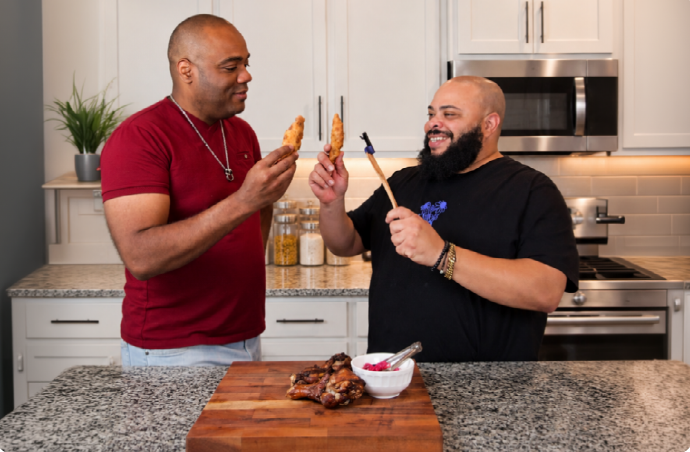
Cooking with Fonkoze: World Cup Edition
Food has always been part of how communities gather, celebrate, and share culture across borders. As the world comes together through sport, Haitian cuisine offers its own form of connection — vibrant, layered, deeply rooted, and meant to be shared.
Chef Alain Lemaire shares two recipes inspired by the energy and spirit of the World Cup: dishes designed for gathering around the table with friends, family, and community.
Chef Lemaire’s Pâté Kode ak Aransò | Haitian Fried Dough with Smoked Herring
The Story Behind the Dish
Found across Haiti in markets, roadside stands, and neighborhood gatherings, pâté kode is a staple of Haitian street food culture. Chef Lemaire’s version highlights the richness of smoked herring balanced with crisp dough and bright pikliz — a combination that reflects the layered flavors and culinary traditions that define Haitian cuisine.
A bold expression of Haitian street cuisine—crispy, savory, and deeply rooted in tradition.
Yield: 10–12 pâté kode
Prep Time: 30 minutes (+ 1 hour rest)
Cook Time: 25–30 minutes
Ingredients
For the Dough
- 2 cups all-purpose flour
- 1 cup water
- 1 tsp salt
For the Smoked Herring Filling (Aransò)
- Smoked herring
- Onion, finely chopped
- Bell pepper, finely chopped
- Scotch bonnet pepper, finely chopped
- Garlic, minced
- Freshly cracked black pepper, to taste
- Shredded cabbage
- Oil, for sautéing
For Assembly & Frying
- Prepared dough
- Prepared herring filling
- Flour, for dusting
- Oil, for frying
- Pikliz, for serving
Method
- In a mixing bowl, combine flour, water, and salt. Knead until smooth and elastic. Cover and allow the dough to rest for at least 1 hour.
- Soak the smoked herring in cold water for at least 1 hour. Finely chop the vegetables and flake the herring.
- Sauté the herring briefly in oil, then add vegetables and black pepper. Cook until softened and fragrant. Allow the filling to cool.
- Roll out the dough thinly and cut into circles. Add filling to the center, fold into half-moons, and seal edges with a fork.
- Fry in hot oil until golden brown and crisp. Drain and serve hot with pikliz.
Chef’s Note
“Pâté kode is more than a snack—it’s a cultural staple. The balance between the crisp dough and the savory, aromatic filling defines its character.”
Chef Lemaire’s Recipe for Poul Fri – Haitian Fried Chicken
Crisp, deeply seasoned, and unmistakably Haitian, poul fri reflects the importance of epis — the foundational seasoning base found in kitchens across Haiti.
For Chef Lemaire, Haitian fried chicken is about technique and flavor rather than heavy batter or excess coating. Marinated in epis, citrus, and spices, the dish captures the bold simplicity that defines many Haitian home-cooked meals.
Yield: 6–8 servings
Prep Time: 20 minutes
Cook Time: 50 minutes
Total Time: 1 hour 10 minutes
The Story Behind the Dish
For Chef Lemaire, Haitian fried chicken is about technique and flavor rather than heavy batter or excess coating. Marinated in epis, citrus, and spices, the dish captures the bold simplicity that defines many Haitian home-cooked meals.
Ingredients
- 9 chicken drumsticks, cleaned & patted dry
- 7 chicken thighs, cleaned & patted dry
- 2 cups Haitian epis
- Kosher salt, to taste
- Freshly cracked black pepper, to taste
- Juice of 1 lemon
- 1 quart vegetable oil (for frying)
- Optional: 4 oz epis (for finishing)
Instructions
- Clean the chicken thoroughly with lime, salt, and warm water. Rinse and pat dry.
- Season chicken with epis, salt, black pepper, and lemon juice.
- Cover and marinate for at least 30 minutes or overnight.
- Heat oil to 385–400°F.
- Fry chicken in small batches for 10–12 minutes until golden brown and cooked through.
- Rest briefly before serving. Optionally finish with fresh epis.
Serving Suggestions
- Pikliz
- Fried plantains
- Rice and beans
Chef’s Note
“No batter, no shortcuts—just flavor. The epis marinade is the foundation, delivering depth, balance, and authenticity in every bite.”
About Chef Lemaire:
In 2025, Chef Lemaire was recognized
among the World’s Top 50 Haitian Cultural
Icons, and his work has been featured in
USA Today, The New York Times, and Food
& Wine Magazine, alongside appearances
on Chopped, Cutthroat Kitchen, and Food
Network Fire Masters.
Find him at: cheflemaire.com