
Food 102: FOOD WE GROW
Haiti Grows Food. A Lot of Different Food.
When people hear about food in Haiti, the conversation often begins with what Haiti does not have. But before we talk about what is missing, let’s talk about what is already growing.
Klas nan sesyon.
Agriculture remains at the heart of rural Haiti. It provides income for most rural families and accounts for approximately 66% of rural employment. At Fonkoze, we work with these farmers, families, and rural communities day in and day out.
And Haiti grows a lot of food.
Our mountains, valleys, plains, different elevations, rainfall patterns, and microclimates mean that what grows in one part of Haiti can look very different from what grows in another.
So, what grows in Haiti?
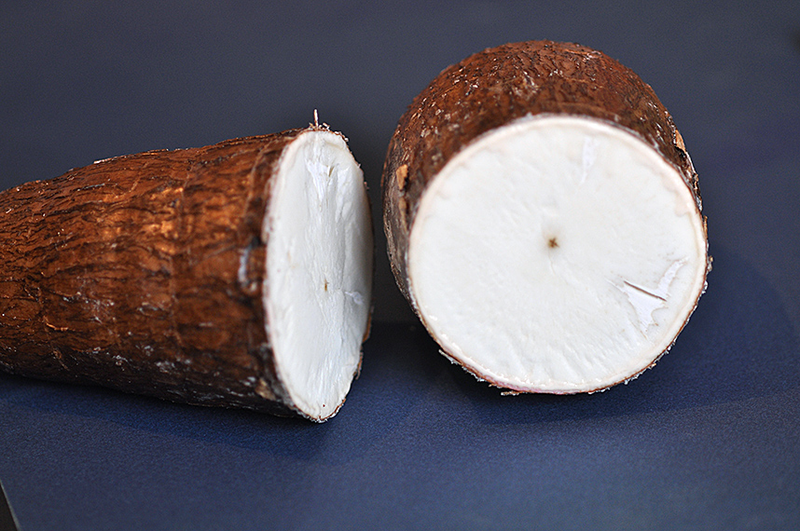
A cross section of Casava By Amada44 – Own work, CC BY 3.0, https://commons.wikimedia.org/w/index.php?curid=12603212
Staples and grains:
Rice • Mayi (corn) • Pitimi (sorghum) • Beans and peas
Roots and tubers:
Manyòk (cassava) • Patat (sweet potato) • Yanm (yam) • Malanga
Plantains and bananas:
Bannann • Fig
Fruits:
Mango • Zaboka (avocado) • Papay (papaya) • Zoranj (orange) • Chadèk (grapefruit) • Sitwon (lime) • Anana (pineapple) • Kokoye (coconut) • Lam veritab (breadfruit)
Vegetables and other foods:
Tomatoes • Cabbage • Eggplant • Peppers • Okra • Leafy greens
And Haitian agriculture isn’t limited to the foods we eat at home. Farmers also produce crops that connect Haiti to international markets, including mangoes, cacao, coffee, and vetiver.
A Country of Small Farms
One of the most important things to understand about Haitian agriculture is scale.
Haiti’s agricultural census counted more than one million farms, with an average size of less than one hectare.
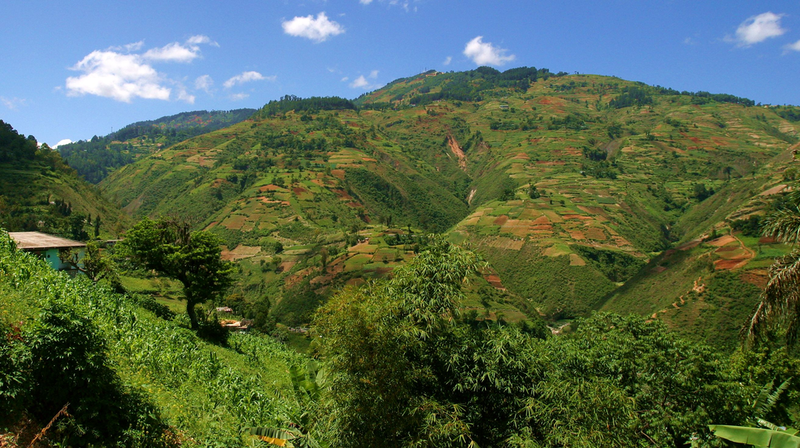
Source: By Jlanghurst – Own work, CC BY-SA 3.0, https://commons.wikimedia.org/w/index.php?curid=32731232
That means much of Haitian agriculture isn’t happening on enormous industrial farms. It happens on relatively small plots cultivated by individuals and families.
But, as with everything in Haiti, small doesn’t mean simple.
A single plot may contain several crops growing alongside one another. We affectionately call this the jaden kreyòl—our traditional system of mixed-crop farming.
Walk through a jaden kreyòl and you might find corn growing alongside beans, plantains near root vegetables, fruit trees overhead, and medicinal or culinary plants tucked between them. A household may also raise goats, chickens, pigs, or cattle.
There is knowledge embedded in that landscape.
But Growing Food Is Only the Beginning
This is where Haiti’s food story gets more complicated. Producing a mango doesn’t mean that mango reaches someone’s table. Before a farmer plants anything, there are already questions.
Do they have access to seeds? Tools? Water? Credit? Labor? These are all questions we help answer at Fonkoze.
Then the crop actually has to grow.
It has to survive drought, excessive rain, hurricanes, pests, disease, and increasingly unpredictable weather. Haitian agriculture remains highly dependent on rainfall, making farmers particularly vulnerable to climate shocks.
And harvesting the food isn’t the end of the journey either.
That mango still has to be collected.
- Stored.
- Transported.
- Sold.
Without adequate roads, refrigeration, processing facilities, storage infrastructure, irrigation, and reliable transportation, some of what Haitian farmers successfully grow can be damaged or lost before anyone ever has the opportunity to eat it.
Years of underinvestment in rural infrastructure, irrigation, agricultural services, and natural-resource management have made those challenges even greater.
The question isn’t simply whether Haitian soil can produce food or whether Haitian farmers know how to farm.
Haiti already grows food well.
A better question is: What do farmers need to grow more productively and sustainably, and what systems need to exist around them so that what they grow can successfully make the journey from the soil to the table?
Because we know investment can make a difference.
Agricultural programs in Haiti have expanded irrigation, introduced improved technologies, established farmer field schools, supported climate-smart agricultural practices, and helped farmers connect to markets. In one World Bank-supported initiative, more than 80% of participating farmers gained better market access after receiving support.
Quick Facts
🌱 Agriculture provides approximately 66% of rural employment in Haiti.
🌱 Haiti has more than one million small farms.
🌱 The average Haitian farm is less than one hectare.
🌱 Haiti’s varied elevations, ecosystems, and microclimates allow farmers to grow an extraordinary variety of crops.
🌱 The jaden kreyòl is a traditional mixed-crop farming system in which multiple plants are cultivated together rather than dedicating an entire plot to a single crop.
🌱 Haitian agriculture produces food for households and domestic markets, as well as internationally traded products including mango, cacao, coffee, and vetiver.
So, here’s what we want you to leave class remembering:
Haiti grows food.
The challenge facing Haitian agriculture isn’t simply whether something can grow in Haitian soil. It is whether farmers have the resources and infrastructure they need to grow it sustainably—and whether the systems surrounding them can help that food make the entire journey from farm to market to table.
This is where the support Fonkoze provides comes into this essential part of the country.
Of course, growing it is only the beginning.
Somebody has to sell it.
Lekòl lage.