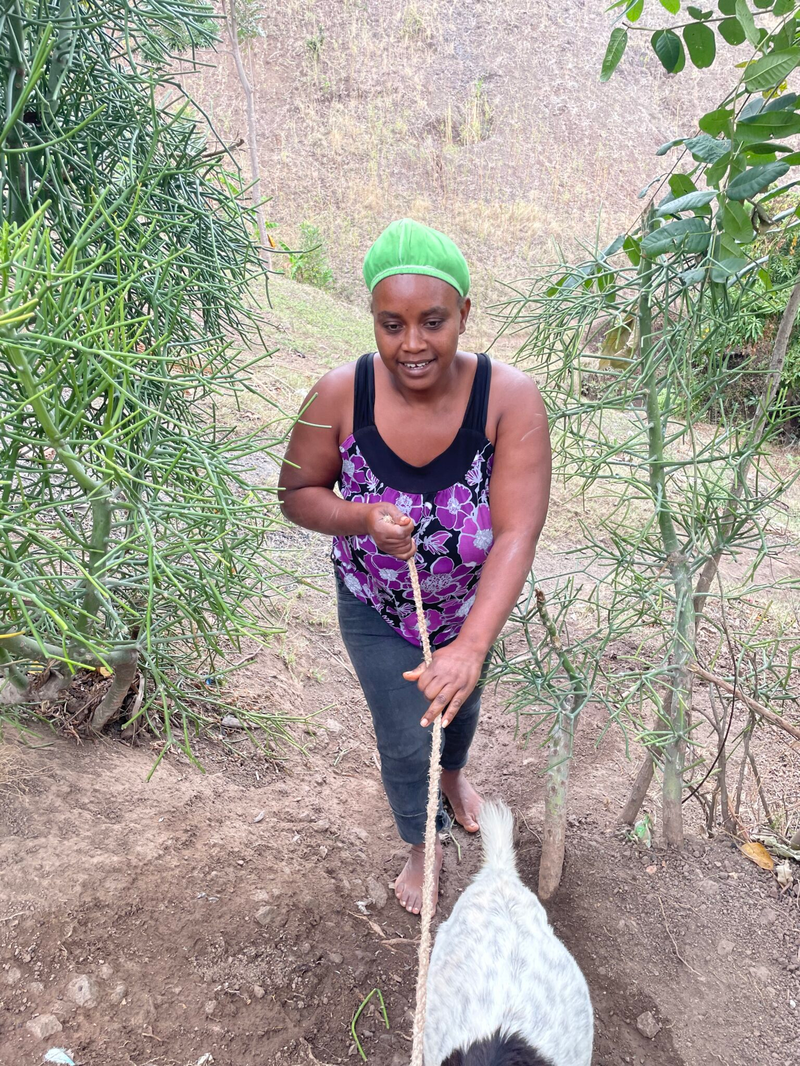
How Nadege Turned Two Goats Into a Path Toward Financial Stability
At the time this post was written, Nadege was 10 months into her 18-month journey though our social promotion program, Chemen Lavi Miyò (CLM).
High above Kalabat, in two rented rooms on a hillside, Nadege has built a life defined by quiet determination and steady decisions.
Her household is full. She lives with her partner, their two children, and now her sister-in-law and her child—family who arrived without explanation, but were welcomed without question. “They are family,” Nadege says simply.
Before joining Fonkoze’s Chemen Lavi Miyò (CLM) program, the family relied on whatever work her partner could find—occasional jobs in masonry or metalwork. Nadege herself had no source of income.
That changed quickly.
With her first investment, she bought two goats. Today, they are four. The goats represent more than growth—they are security. “If my business falls apart, I can always sell a goat,” she explains. They are a safeguard against uncertainty, and a way to meet larger needs like school fees.
At the same time, Nadege launched a small business selling rum from her home. She buys in bulk from Gwomòn and sells it in smaller quantities to neighbors who come with their own bottles. While many vendors travel to crowded gatherings to sell, Nadege made a deliberate choice. “I don’t like being around the shouting and the fights,” she says. “Sometimes they throw rocks.” Instead, she built a business on her own terms—stable, local, and consistent.
The income she earns supports her household, but just as importantly, it allows her to save. Each week, she contributes to her savings and loan association, planning ahead to grow her livestock. She also participates in a sòl, a traditional savings group. She isn’t in a hurry for her payout. “They can give me the last turn if they want to,” she says.
Because Nadege has a plan.
When her turn comes, she won’t simply expand her rum sales—she’ll diversify. She plans to begin selling epis, the essential spices that form the foundation of Haitian cooking: garlic, leeks, peppers, cloves, and more. Two businesses. Two steady streams of income.
And step by step, she’s building toward something even bigger.
On a nearby plot of land, construction has already begun on her future home. A new latrine is in place. Soon, she and her family will leave the rented rooms behind.
Nadege’s progress is not sudden or flashy. It is deliberate. Layered. Built on discipline, foresight, and care for those around her.
She is not just increasing her income—she is reducing her vulnerability, creating options, and shaping a more stable future for her family.
Join us today in helping more women like Nadege.